
The following text is excerpted from two interviews held on August 25 and 26, 2025, between the artist Louis Fratino and BMA curators Katy Rothkopf and Virginia Anderson. The exhibition Fratino and Matisse: To See This Light Again is on view at the BMA through September 6, 2026.
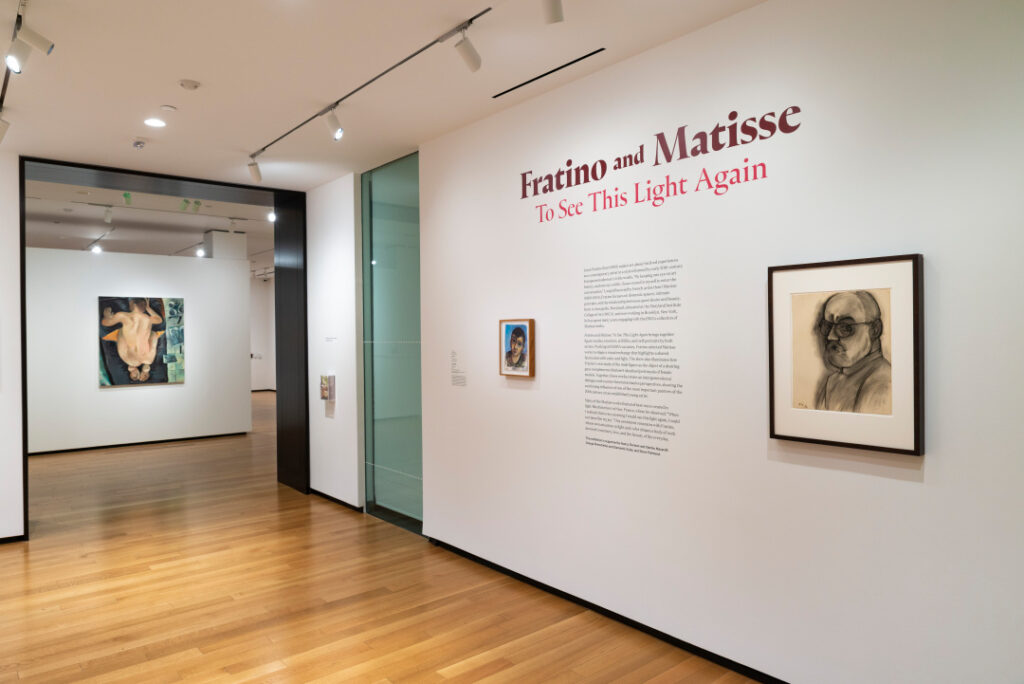
Katy Rothkopf: Can you share your earliest memories of visiting the BMA? When did you first encounter Matisse’s work?
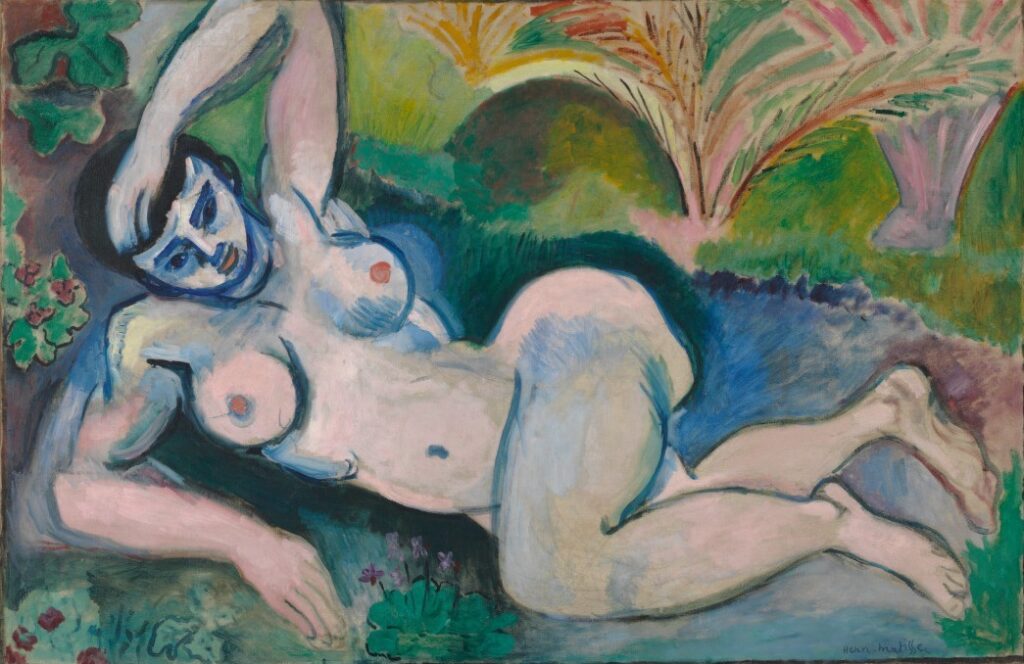
Louis Fratino: It was actually when I was a student at MICA [the Maryland Institute College of Art, from which Fratino graduated in 2015], which is kind of crazy since I’m from Maryland. But I remember being blown away and really proud that Baltimore had such a world-class collection of Matisse paintings. Probably the Blue Nude is one that sticks out as a real “oh my god, that’s here?” feeling. So, that was when I was a freshman in college. It was not my first time seeing Matisse, but it was certainly my first time seeing such an incredible amount of Matisse together. The first Matisse I ever saw was probably at the National Gallery [Washington, D.C.], which I visited with my family.
KR: How has the BMA’s Matisse collection shaped your growth as an artist?
LF: Being able to visit the BMA and spend such intimate time with that work is an opportunity that not a lot of people have. I’m sure that’s a big part of why he is such a consistent influence on my work, that I was able to forge a much more intense relationship than if I had merely a preliminary interest in Matisse but could experience it only through books or pictures. It would have been something very different.
Virginia Anderson: What elements of Matisse’s art do you connect with most? What aspects of it really resonate with you?
LF: I think it’s the idea that art manifests a kind of attention or a vision for your life, that it can be a beautiful life despite certain circumstances that may be happening around you. In Matisse’s case, he lived through the First and Second World Wars. Painting can confirm that life is beautiful and that it’s worth looking at. I do feel that it gives back to me that way: I see my surroundings and my garden or the people I’m around differently because I’ve had the opportunity to paint them. That’s a feeling I get from Matisse. By keeping one eye on art history and one eye on life, I leave room for myself to enter the conversation.
Something that I’ve always loved about Matisse’s work is that there’s an openness about process and materiality that’s counterbalanced by the sophistication of the line. The work would be less beautiful if it were only sophistication; there’s an openness to roughness, to failure, to rethinking, that makes the work feel really human and more beautiful.
VA: Is it that something is beautiful and therefore you want to capture it, or is it that by capturing it, you’re making it beautiful?
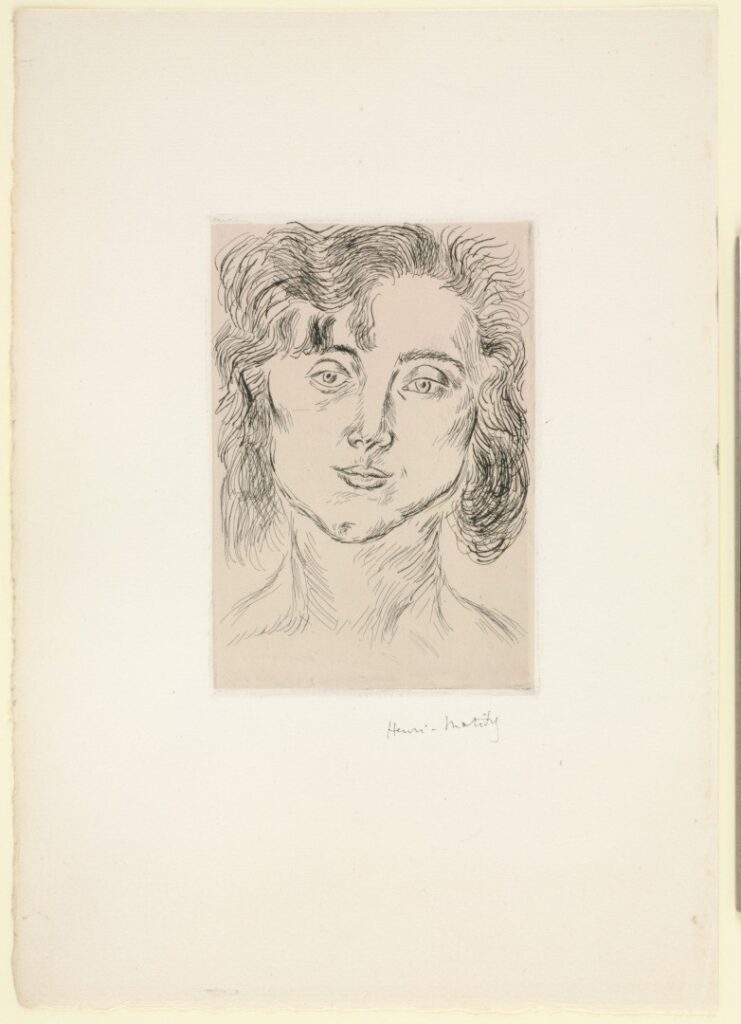
LF: That’s the mystery of painting, because it’s got a physical life of its own. Did I just affect my life by painting it, or am I capturing some emotion that was already there? Matisse talks about the translation of his feeling; his Nice paintings were criticized for their naturalism, and his response was, “If by naturalism [my critics] mean that I’m translating according to my feeling, then by all means, yes.” I want my paintings to have such intense feeling. They are obviously about drawing and color and light, but that’s all in support of a very rich, very beautiful quality of softness or color or sensation that is recognizable even if it’s not “natural” in the academic sense.
KR: How does your own lived experience influence the way you approach and reimagine subject matter?
LF: I came out when I was in art school. All of a sudden, I had this license to play with art history in a way that I hadn’t before. Maybe I didn’t feel as though I knew where I fit within it before that. There’s an archive of the female nude and not a lot of the male nude. That was just a really exciting moment for me that lined up simultaneously with coming out—I wanted to be in conversation with all these painters that I loved. I felt like I had found the language for it because I was able to work with this subject matter that I was less comfortable with beforehand. That was a major switch for me, representing my body or bodies that I desire, that didn’t have to go through this filter or disguise or a lack of honesty about that desire. And so all of a sudden, I saw those historical paintings differently, in that they are about appreciating the human form too. I know that there is understandable criticism about objectification of the body, but I think that in Matisse’s case, [the nudes] are about the joy of looking at the world around him as much as at the human body. I took a lot of license from that and continue to.
Matisse paints the work he makes, and he’s creating this world the same way he creates paintings. He’s composing the interiors around him to be spaces that he finds beautiful. I’ve taken that as a cue for my personal life.
VA: Can you walk us through a moment when you transformed an idea from art history into something distinctly your own?
LF: Jo Smail was my professor at MICA. She focuses a lot on play, talking to her students about play. For me, transformation happens in that moment when it’s about imagining or visualizing something that you want to see in the world—but maybe isn’t there—and having the freedom to play and imagine. It’s reimagining the subjects while I’m borrowing the color, the composition, all these formal elements that make a painting work. In the narrative or conceptual world built around it, I can make small decisions, like switching the gender [of the subject] or putting in someone I know or making it in my lived space. It becomes about my lived experience.
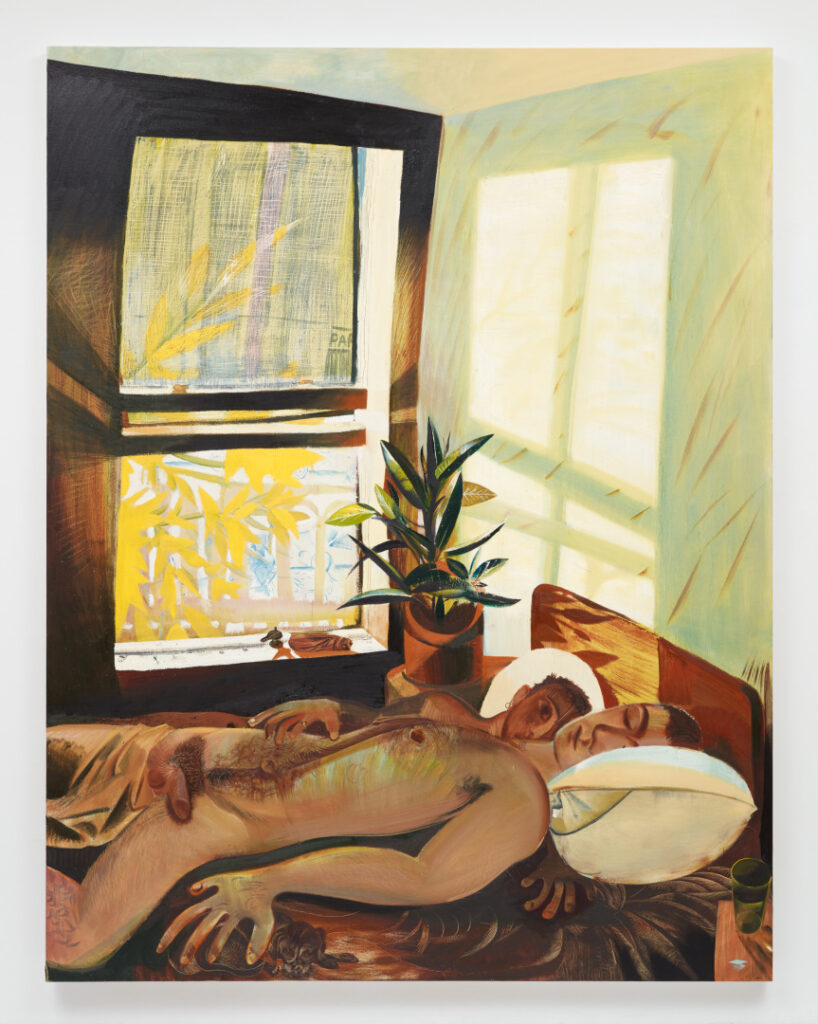
KR: Matisse was working with models with whom he didn’t necessarily have a personal relationship. How do you feel that comes across in his art making, as opposed to, for you, doing images of people you love? Do you feel that there’s a bit of the theater of Matisse that reads very differently from what you’re doing, or does it feel like there’s a big similarity?
LF: Matisse was a really invested looker. Even if there wasn’t a familial intimacy or romantic intimacy, he brought a kind of energy so that the result is very intimate.
I like the scenes not to be constructed; I like them to be found. And so, in a way, I’m probably just a different person than Matisse. Like, the idea of draping a specific color behind a model to make a composition seems ludicrous to me, but I totally understand the kind of formal impulse to do that. There’s something Matisse said that has stuck with me. People asked him, “How could you make such monstrous-looking women?” because in their time, people were so shocked [by his art]. And he responded, “Luckily, I don’t make women. I make paintings.” I think it’s kind of similar, in that people ask me, “How could you reveal such an intimate, vulnerable side of yourself?” I’m revealing a painting, actually. At the end of the day, what’s being made is a painting. That’s beautiful.
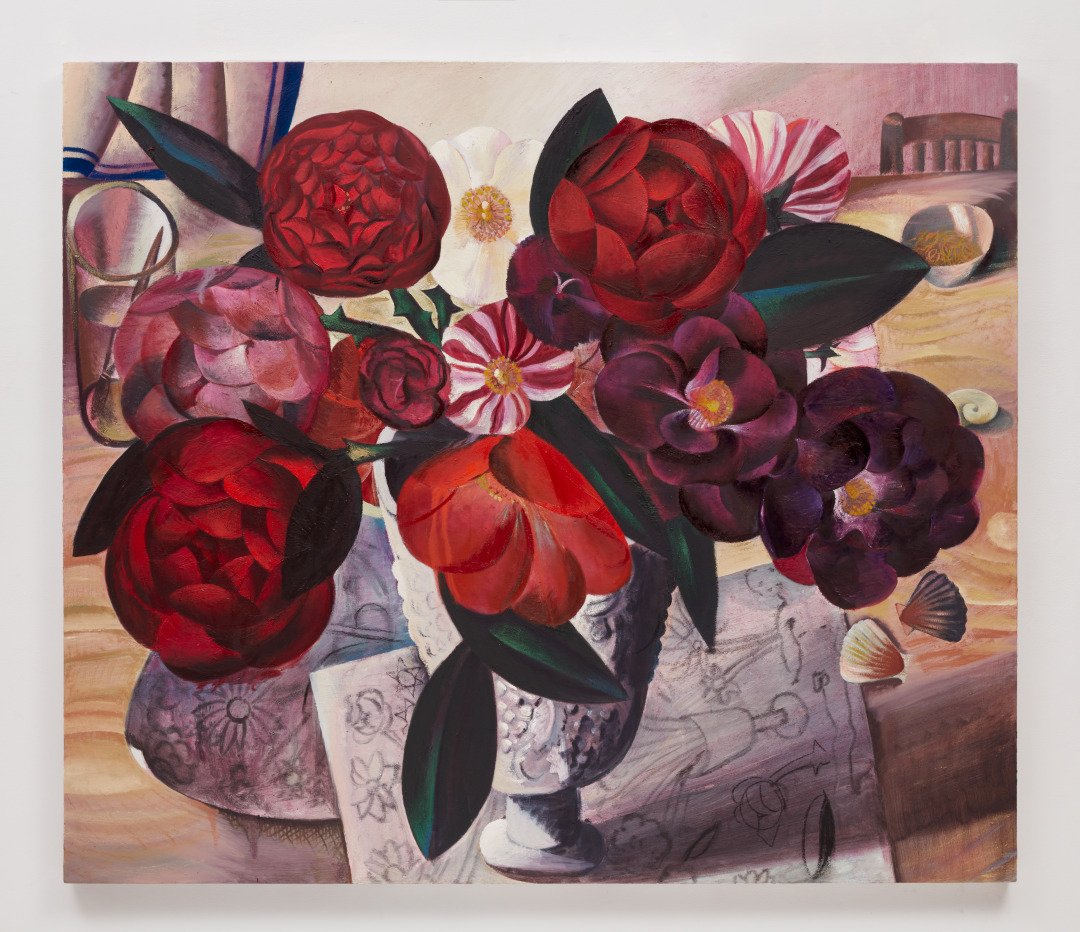
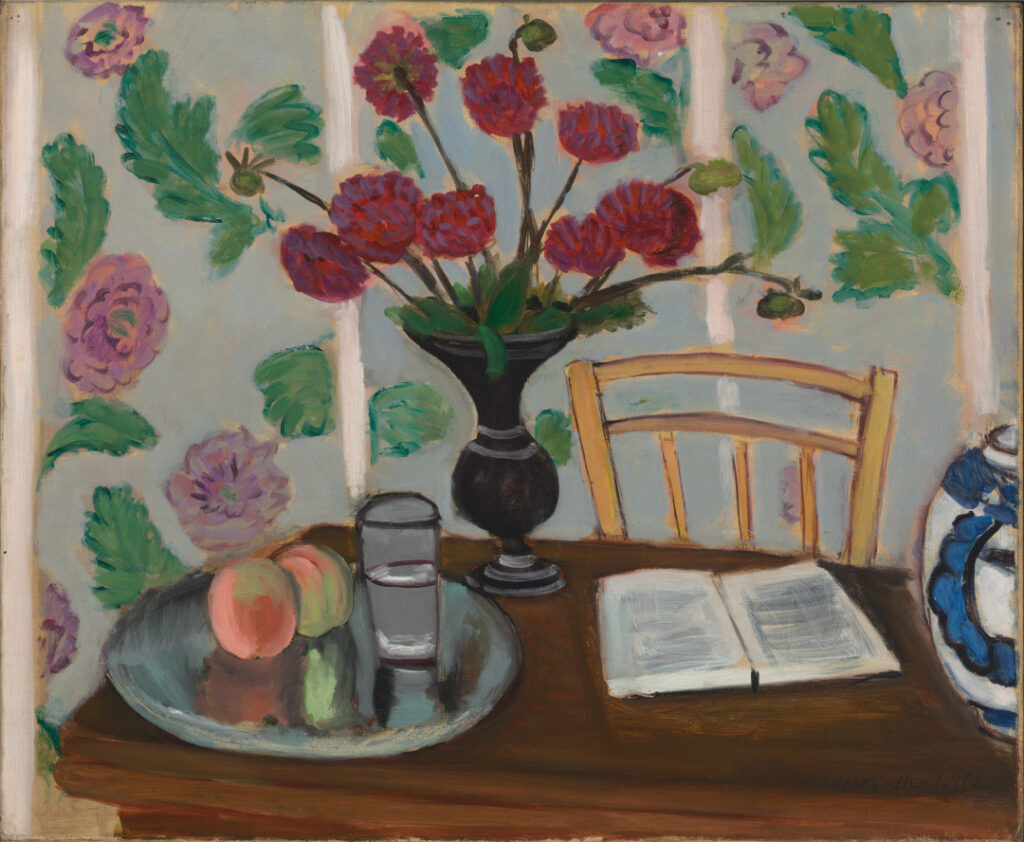
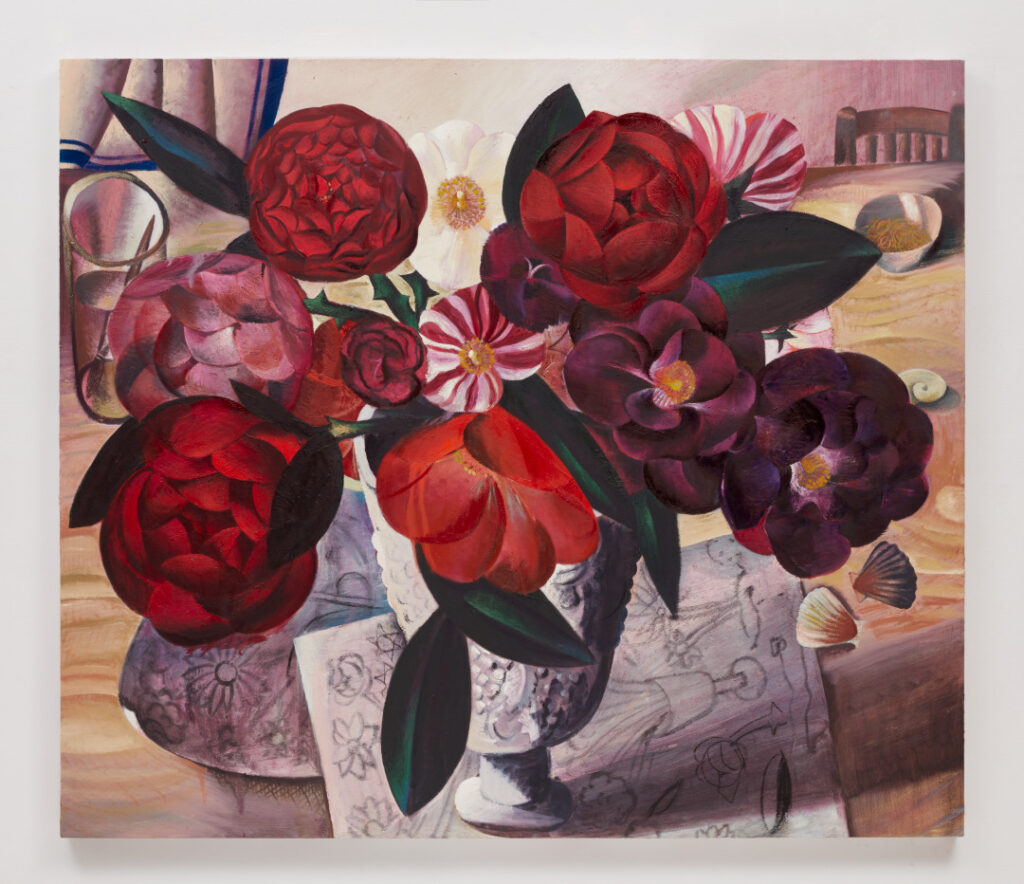
Something I think about and I’ve learned from Matisse is that there can be two modes of representation within a painting of the same subject. That happens a lot in his work, where there are flowers printed on wallpaper and then there are flowers that are in theory in a physical space and are real flowers. I think it’s something I see David Hockney do too—it’s about entering a space with an adjusted idea of reality or naturalism. You believe the painted world more deeply because of these signifiers, almost functioning like a dream.
KR: When viewers look at your work, what kind of gaze or perspective do you hope they experience?
LF: The thing that always makes me feel the best is when I hear people saying that they recognize the subject—that despite maybe not being in that space, or knowing who I am, or who is being depicted, there’s a sensation that reminds them of themselves or of something that they’ve experienced. It could be someone who’s much older than me or someone who’s much younger than me or someone from a different walk of life. That’s the goal: to make an image that, despite its more superficial content, reaches something more emotionally universal [in the viewer].
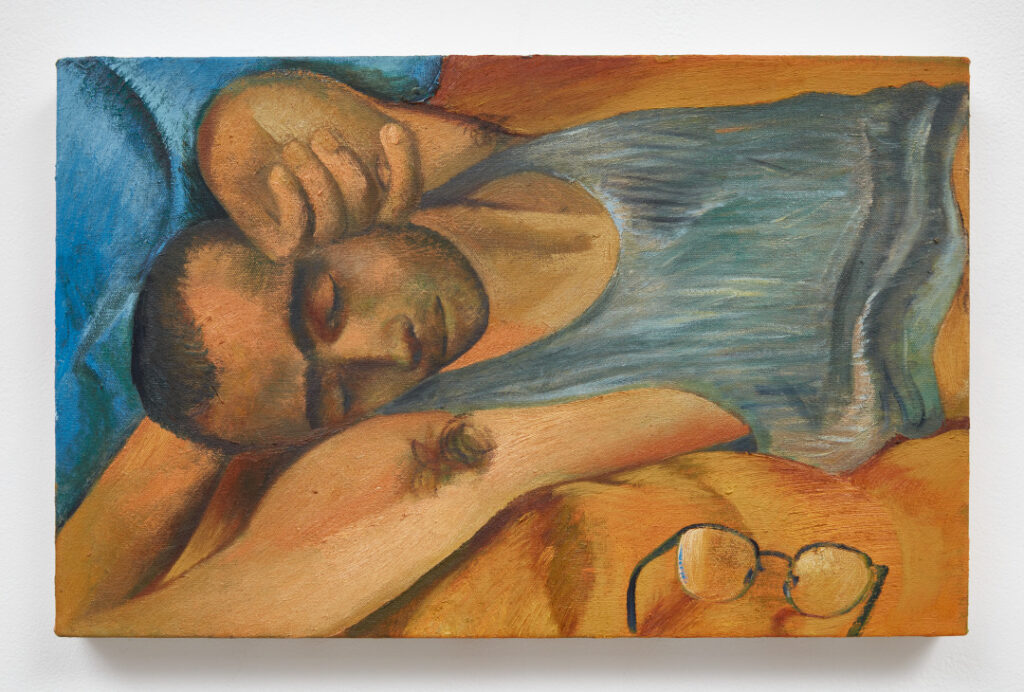
VA: How do you translate your memories and personal experiences into the dreamlike imagery of your paintings?
LF: I keep quoting Matisse. He says something like, “It’s only when I’m in direct accord with my sensations that I feel like I have the right to depart from nature.” That makes a lot of sense to me. It’s when a memory is known so intimately that you kind of have the ability to abstract or stylize a situation to reinforce the feeling of it. I love how Matisse and I think that painting your environment is always this balance between construction and observation. I imagine Matisse lived—and I live—in a way in which he was constantly composing potential paintings through the things that surrounded and nourished him. This kind of attention is completely unnecessary in day-to-day life but totally necessary for painting.
VA: How do you see yourself within the broader context of contemporary figurative art?
LF: I feel lucky to be making the work that I’m doing now. It would probably have been harder in a different moment. A lot of painters have made similar work but weren’t able to provide for themselves professionally with the kind of subject matter that I’m interested in—specifically queer people representing their intimate lives. I feel lucky to be part of the contemporary moment that accommodates that.
KR: You are inspired by artists of the past. It’s a long-standing practice in the history of painting for artists to riff on their predecessors’ work. How do you fit into that tradition?
LF: I have a lot of license to work the way I do, because it’s actually how so much painting is made. Vincent van Gogh looked a lot at Eugène Delacroix, and he made some amazing paintings that were just copies of Delacroix paintings. And Delacroix did the same, copying Peter Paul Rubens. These are big names and big things, but I think it happens at every level. That’s my understanding of how painting is made and how I enjoy making it.
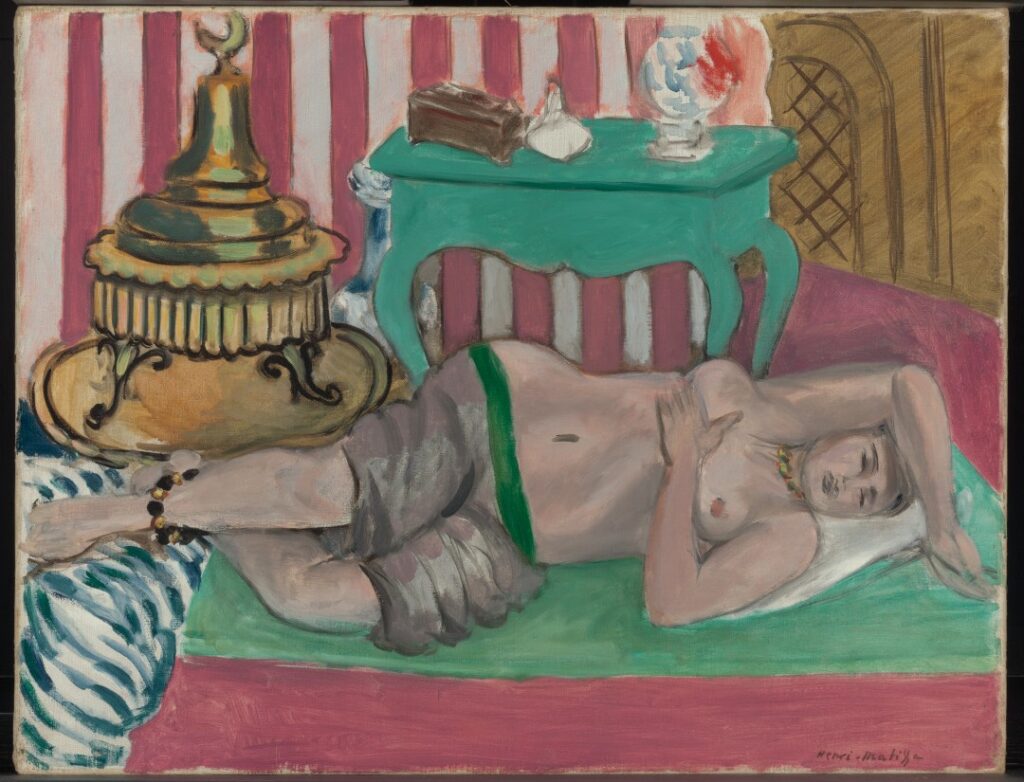
KR: It’s looking to the past for inspiration but making something that’s very you and very contemporary.
LF: A funny thing, this era of painting, is it doesn’t feel like the past. It feels so alive. It’s not like dredging up this dusty thing and trying to figure out how to make it work for today. It’s that it will work for yesterday, today, and tomorrow, because it’s great art.
VA: When visitors compare your work with Matisse’s, what questions do you hope they’ll ask themselves? Or what do you hope they’ll notice when they look closely at your paintings?
LF: It would be ludicrous to imagine someone who doesn’t already care about Matisse! But if this [exhibition] provided some entryway for someone who cared more about contemporary artwork, then that would be great. It feels a little self-aggrandizing even to insinuate that. … I guess I would want them to notice the obvious narrative around queer identity, the contemporary queer landscape that exists in painting now that didn’t exist when Matisse was making paintings.
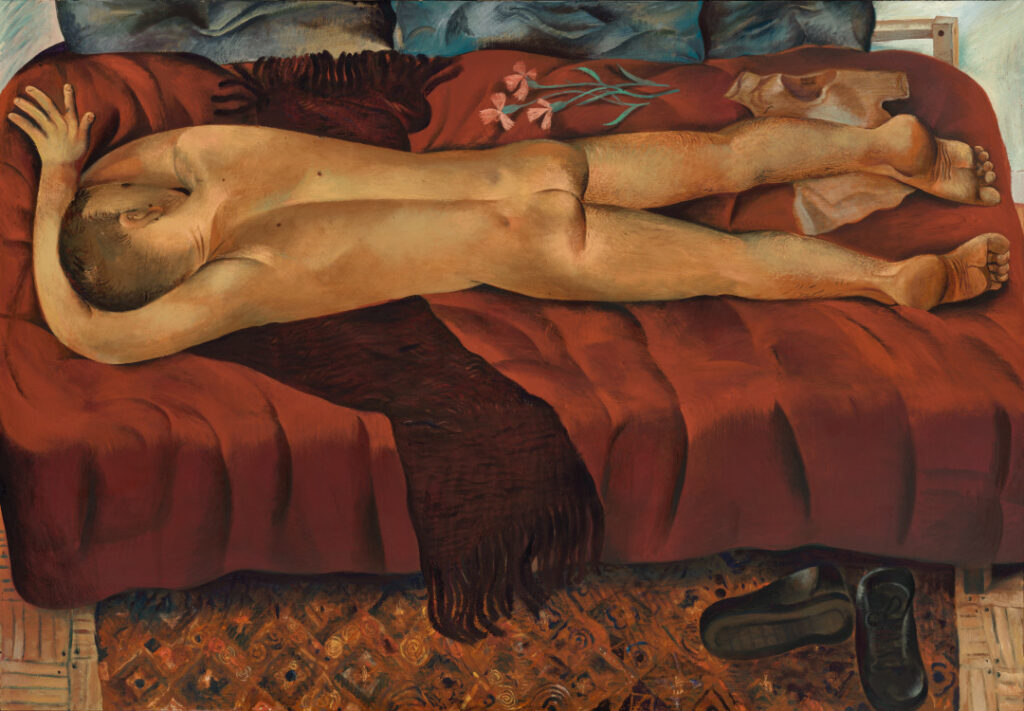
There’s a way to make something in a beautiful way that is universal, that isn’t about gender necessarily all the time or even sexual identity. My interest in Matisse doesn’t come from that [sexual identity] either; it’s not about trying to get revenge on not being included in the work. It’s just seeing that there are all these amazing ideas there that I get to kind of take from. There’s a way for queer people to see themselves in work that might not address queer subjects because the nude belongs to a human community like art history does, and there’s nothing in the way of turning it into something that’s useful for you or your story, if that makes sense. It’s so easy to translate a Matisse odalisque into a male nude because it’s really not that different: the curve of the hip or the sensuality that exists in the female nude functions exactly the same way, and sometimes I try to emphasize that by even rounding the forms purposely, even finding femininity in a masculine nude, which I think is really beautiful. The bodies themselves perhaps aren’t that different, and the question is, Who’s looking at them, and who’s finding the beauty? Right?
KR: What would you want visitors to know? Is there something you’d like them to feel even if they can’t put it into words?
LF: I think the best painting makes people want to try to paint—or at least it always does for me. It’s a very personal relationship I have with painting, but I always want to get back to the studio when I see painting. It’s both a challenge and an invitation to try something that you notice in painting, and Matisse is definitely like that for me: a challenge and an invitation.
Fratino and Matisse: To See This Light Again is supported by Nancy Dorman and Stanley Mazaroff, George Petrocheilos and Diamantis Xylas, and Steve Pulimood.